


Retrosynthetic Analysis of 2-Bromo-4-Chloro-3-Fluorobenzoic Acid
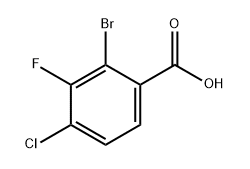
Retrosynthetic analysis serves as the foundation for designing efficient synthetic routes for 2-Bromo-4-Chloro-3-Fluorobenzoic Acid. By deconstructing the molecule into simpler halogenated intermediates, chemists can identify strategic disconnections, optimize reaction sequences, and minimize side reactions. Typically, the molecule is visualized as a substituted benzoic acid core with bromine at position 2, chlorine at position 4, and fluorine at position 3. Key considerations during retrosynthesis include electronic effects of substituents, steric hindrance, and potential for over-halogenation, which are crucial for multi-halogenated aromatic compounds. Selecting appropriate precursors, such as 3-fluorobenzoic acid derivatives, enables targeted halogenation while maintaining regioselectivity.
Electrophilic Aromatic Substitution in Halogenated Benzoic Acid Synthesis
Electrophilic aromatic substitution (EAS) remains a cornerstone in polyhalogenated benzoic acid synthesis. Bromination and chlorination reactions are generally performed under controlled conditions to ensure selective substitution at desired positions. For instance, bromination at the ortho position relative to the carboxylic acid group requires careful selection of catalysts such as FeBr₃ or AlBr₃, as well as temperature control to prevent polybromination. Chlorination strategies often employ N-chlorosuccinimide (NCS) or Cl₂ in the presence of Lewis acids to achieve site-specific halogenation. Optimizing solvent systems, such as dichloromethane or acetic acid, can further enhance reaction efficiency and product yield. Mastery of EAS techniques is essential for achieving high-purity 2-Bromo-4-Chloro-3-Fluorobenzoic Acid suitable for downstream applications.
Directed Ortho-Metalation Strategies
Directed ortho-metalation (DoM) offers an alternative and highly selective approach for installing substituents on polyhalogenated benzoic acids. Using strong bases like lithium diisopropylamide (LDA) or organolithium reagents, chemists can deprotonate the aromatic ring ortho to a directing group, such as a carboxyl or ester functionality. Subsequent reactions with halogen sources allow the introduction of bromine or fluorine at precise positions. DoM strategies are particularly valuable for molecules like 2-Bromo-4-Chloro-3-Fluorobenzoic Acid, where conventional EAS may lead to regioisomer mixtures. This technique not only enhances regioselectivity but also reduces the need for extensive purification steps, making it suitable for scale-up and pharmaceutical synthesis.
Regioselectivity Challenges in Multi-Halogenation
Achieving regioselectivity is one of the primary challenges in synthesizing multi-halogenated benzoic acids. Competing electronic and steric effects of existing substituents can lead to undesired positional isomers. In 2-Bromo-4-Chloro-3-Fluorobenzoic Acid synthesis, the interplay between bromine, chlorine, and fluorine atoms requires careful reaction planning, sequence optimization, and reagent selection. Computational predictions and empirical studies often guide chemists in selecting the order of halogenation steps to maximize yield and minimize byproducts. Additionally, protecting group strategies can temporarily block reactive positions, further improving regioselective outcomes. Addressing these challenges is critical for producing high-purity compounds necessary for chemical intermediates or pharmaceutical applications.
Fluorination Techniques in Aromatic Systems
Fluorination represents a crucial step in synthesizing 2-Bromo-4-Chloro-3-Fluorobenzoic Acid due to the unique chemical properties imparted by fluorine atoms. Electrophilic fluorination agents, such as Selectfluor or N-fluorobenzenesulfonimide (NFSI), enable selective introduction of fluorine at electron-rich aromatic positions. Alternatively, nucleophilic fluorination using KF in polar aprotic solvents provides access to specific fluorinated intermediates. Fluorination not only affects the reactivity of the aromatic ring but also enhances metabolic stability, lipophilicity, and bioactivity in pharmaceutical derivatives. Careful control of reaction conditions, including temperature, solvent choice, and halogen source, ensures high regioselectivity and minimizes undesired side reactions.
